Rothko for $85.8 million: What does the sale of Brown and Blacks in Reds say about the art market in 2026?
May 20, 2026
The sale Brown and Blacks in Reds for $85.8 million isn't just a story about the high price of a single painting. It's a signal from the upper echelons of the art market: capital is returning to museum-quality works, but selectively.
The 1957 painting came to market just as the global art market was emerging from a period of caution. According to Art Basel and UBS, global art sales are expected to rise 4% to $59.6 billion in 2025, while public auction values are projected to rise 9% to $20.7 billion.
In Rothko's case, date, scale, and provenance are particularly important. Brown and Blacks in Reds belongs to the period of mature color-field paintings, and the artist's large-scale canvases from the 1950s rarely appear on the open market.
What exactly happened at the Sotheby's auction?
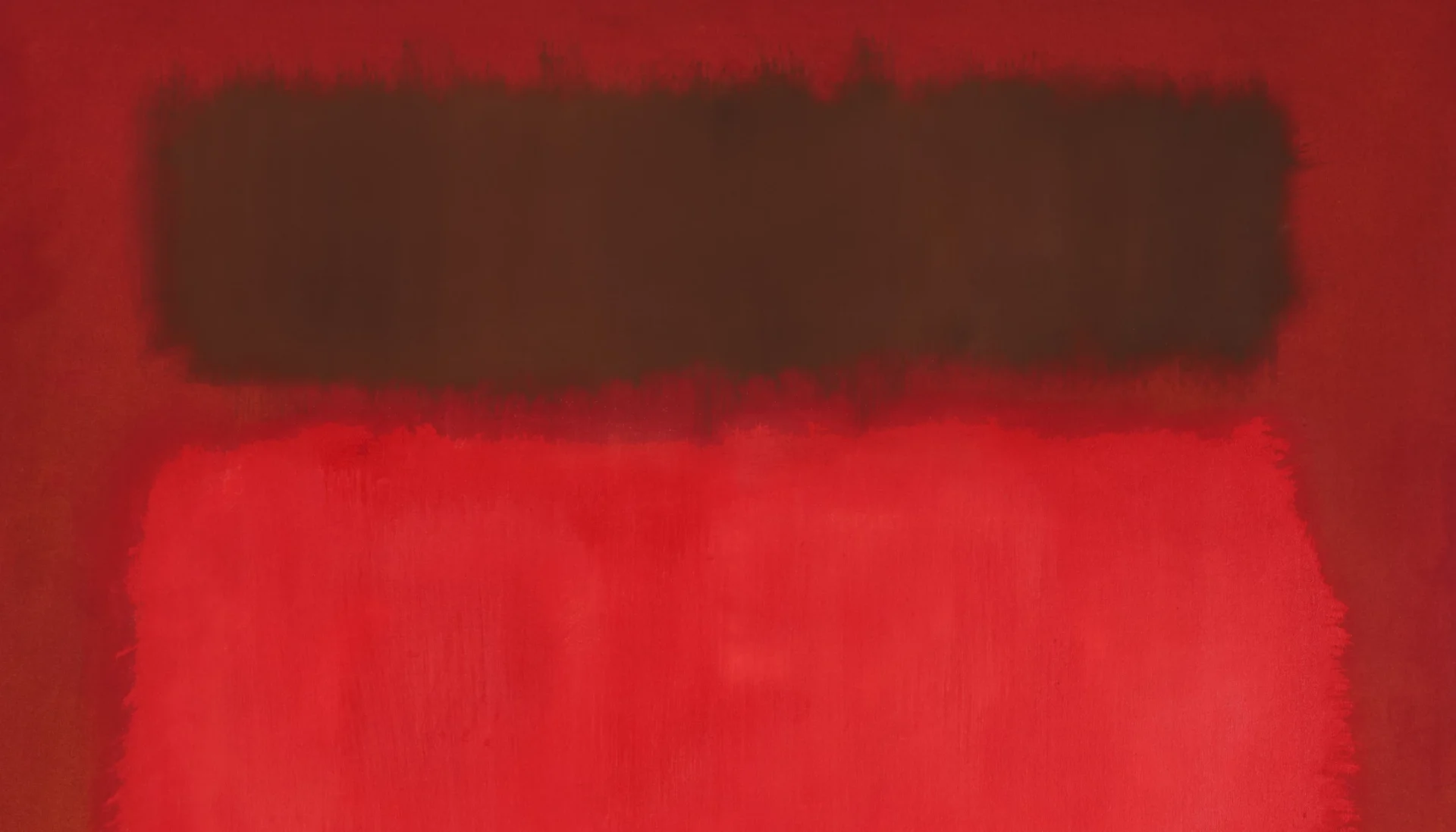
Brown and Blacks in Reds sold at Sotheby's for $85.8 million, against an estimate of $70-100 million.
Brown and Blacks in Reds - Image, Estimation and Result
Sotheby's described the work as an oil on canvas, executed in 1957, measuring 90 1/2 × 60 1/2 inches, or 229.9 × 154 cm. The painting was offered as a lot in the Robert Mnuchin: Collector at Heart and was listed as Guaranteed Property with Irrevocable Bids.
The $85.8 million price confirmed that the top end of the Rothko market remains active. The price approached the artist's historical highs and demonstrated that collectors are willing to pay more for works of large scale, strong provenance, and a recognizable place in the oeuvre.
Who was Robert Mnuchin and why did provenance matter?
Robert Mnuchin was a former Goldman Sachs banker, art collector, and dealer. The WSJ reported that he purchased "Browns and Blacks in Reds" in 2003 for $6.7 million, and in 2026, the work was sold from his collection for $85.8 million.
In the trophy art segment, provenance isn't a footnote. It's part of the value. It signifies the history of ownership, the reputation of the collector's eye, and the market's confidence in the object. In this case, the work's prior connections with prestigious institutional and collector circuits also played a role.
Why is 1957 a key year in Rothko's work?
The year 1957 marks the period of Rothko's mature color-field paintings. The artist was no longer searching for language. He developed a formula for large, softly pulsating color fields in which color, scale, and the tension between rectangular planes built the emotional weight of the painting.
Rothko's large-scale works from the 1950s are rare on the market, as many are held in museums or long-term collections. It is this limited supply, not the artist's name itself, that creates the auction excitement surrounding such works.
format and palette mean the Brown and Blacks in Reds?
The painting's format places it in the category of Rothko's monumental canvases. Dark fields on a red background combine the intensity of color with the tension between light, weight, and contemplation characteristic of the late 1950s.
However, the value of a work shouldn't be reduced solely to the color red. The market interprets such a painting through a combination of parameters: date, scale, condition, provenance, place in the artist's oeuvre, and the rarity of comparable works.
Was this a record sale for Rothko?
The sale of Brown and Blacks in Reds was close to Rothko's record, but in the perspective of the entire month of May 2026 it did not remain the artist's record.
Close to the record, but not the record for the entire month of May 2026
At the time of sale, the $85.8 million result was one of the highest auction results for a Rothka and approached the level of Orange, Red, Yellow, which sold in 2012 for $86.88 million. (Wall Street Journal)
A few days later , No. 15 (Two Greens and Red Stripe) from 1964 fetched $98.39 million at Christie's, setting a new auction record for a Rothko. (HENI)
Why do headlines about “record” need to be clarified?
In the art market, the word "record" requires a date, a category, and context. The hierarchy of results can change within a few days of a single auction season.
Brown and Blacks in Reds can therefore be described as a near-record transaction and one of Rothko's highest sales, but not as the artist's current auction record following the sale of No. 15.
What does the comparison with Orange, Red, Yellow and No. 15?
Comparing these three results shows that Rothko remains one of the most important names in postwar abstract art. However, the market doesn't pay solely for the signature. A premium arises where the name is combined with the correct date, format, palette, ownership history, and scarcity.
What does this transaction say about the global art market in May 2026?
The Rothka transaction shows that the art market will rebound in 2026, but primarily in the blue-chip art segment.
Demand for blue-chip art returns
Art Basel and UBS indicate that after two years of decline, the global art market will return to growth in 2025. The increase in public auctions was particularly significant, reaching $20.7 billion.
The Rothko sale fits this picture well. Capital flows back not evenly to the entire market, but to works that are easily recognizable, rare, and institutionally recognized.
The market is strong but selective
The strongest demand is for works of the highest quality: canonical artists, large formats, prestigious collections, and objects with a clear history. Artnet noted that May auctions in New York included works with very high estimates, and the Rothko from the Mnuchin collection was one of the most important lots of the season.
This doesn't mean the entire market is euphoric. Younger contemporary art, the speculative segment, and works of lesser provenance remain more sensitive to changes in collector sentiment.
Auction guarantees as a safety mechanism
Guaranteed Property and Irrevocable Bids status means that the sale was secured with mechanisms that limit the seller's risk. Such solutions help auction houses acquire the most important items. The guarantee does not diminish the prestige of the work. However, it does affect how the result is interpreted, as the auction price is then part of a more complex financial structure.
Why does a Rothko remain a top-tier luxury collectible?
Mark Rothko's paintings continue to rank among the highest-class collectibles because they combine canonical artistic standing with a limited supply of museum-quality works.
The rarity of museum-quality works
Rothko's finest works from the 1950s and 1960s rarely come to auction. Many are held by museums, foundations, or collections that don't have a short-term sales horizon.
The market for high-end art operates differently than the market for mass-produced luxury goods. Here, value derives from uniqueness, history, and the impossibility of replicating supply.
The year 1957 and the mature language of color-field painting
In the second half of the 1950s, Rothko created paintings in which planes of color became experiences of scale, silence, and tension. It was this period that established his highest market position.
For a collector, not every Rothko work carries the same weight. What matters are the date, format, palette, quality of execution, and place in the artist's creative trajectory.
The universal language of abstraction
Rothko is accessible to global collectors because his works do not require knowledge of local iconographic codes. Their status stems from their canonization in museums and the recognizable language of abstraction.
This facilitates global circulation. The painter's works simultaneously thrive in the imaginations of American, European, and Asian collectors.
Red, Scale, and Emotional Recognition
Intense reds and dark color fields are among Rothko's most recognizable registers. In Brown and Blacks in Reds, dark rectangles against a red background create a tension that aligns well with the artist's commercially desirable imagery.
A palette doesn't automatically raise the price. It enhances the work's appeal when combined with the appropriate date, scale, and provenance.
How to read this sale from the perspective of an HNWI collector?
From an HNWI collector's perspective, this sale is a lesson in quality and timing, not a simple investment manual.
This is not a simple investment case
The increase from $6.7 million in 2003 to $85.8 million in 2026 looks spectacular. However, it should not be presented as a simple return model.
At this level, art is a highly symbolic and illiquid asset. Transaction costs, taxes, insurance, storage, maintenance, consulting, and exit risk are also added.
The most important things are quality, provenance and time horizon
The market rewards exceptional work but doesn't guarantee a similar outcome for average objects. Collecting at this level requires access, patience, and the ability to hold onto a work for many years.
Trophy art as an element of status and capital allocation
Trophy art is a combination of cultural, social, and financial assets. In Rothko's case, capital buys not just a painting but a share in the canon of postwar abstraction.
A better term than “safe investment” is: an asset with limited supply, high symbolism and low liquidity.
What does May 2026 mean for the upcoming auction season?
May 2026 confirms that the highest segment of the art market has regained confidence faster than the more speculative segments.
New York auctions as a market barometer
May auctions in New York tested collector confidence after a period of correction. Rothko results at Sotheby's and Christie's showed that demand remains active at the top of the pyramid.
Christie's, Sotheby's and the competition for private collections
Today, major auction houses compete not only for individual paintings but also for entire private collections, estate sales, and single-owner collections. In this context, Robert Mnuchin's collection was not only a source of supply but also a market narrative.
Market Conclusion
The Rothko transaction doesn't signal market-wide euphoria. Rather, it signals capital returning to where quality, rarity, and provenance are most defensible.
In short:
- Brown and Blacks in Reds sold at Sotheby's for $85.8 million.
- The painting dates from 1957, i.e. from the period of Rothko's mature color-field paintings.
- Rothko's large-scale works from the 1950s are rare on the market, as many are held in museums or long-term collections.
- The transaction was close to a record for the artist, but after the sale of No. 15 (Two Greens and Red Stripe) for $98.39 million, it no longer holds the record.
- The sale demonstrates the strength of the blue-chip art market, especially for works of rare provenance, large scale and canonical significance.
The sale of "Brown and Black in Reds" is less a story about a one-off record and more a precise signal from the top end of the market. In 2026, capital is returning to art, but above all to works that combine rarity, provenance, museum quality, and global recognition.
Sources:
- UBS (United States of America)
- Sotheby's (Sothebys.com)
- Wall Street Journal (Wall Street Journal)
- Artnet News (Artnet News)